[co-authors: Julien Halfon, Vincent Mayot, Phil Dawes]
It is estimated that over the coming decades, decommissioning redundant and end-of-life energy, mining, industrial, waste management and shipping assets will cost at least USD 8 trillion. Including nuclear energy, only about USD 0.5 trillion of these liabilities have been pre-funded. So USD 7.5 trillion worth of decommissioning obligations solely rely on creditworthiness of their operator at the time of decommissioning.
Decommissioning therefore poses a significant global financial challenge. Asset owners face issues arising from operational costs and decommissioning programme management, capacity constraints, workforce and community needs and long-term financial provision.
In this briefing, written in partnership with our client BNP PARIBAS Asset Management (BNPP AM), we review new financial strategies and funding options, such as decommissioning reserve funds and decommissioning bonds, which will help asset owners plan and finance decommissioning, demonstrate commitment to transition activities, align with national and corporate transition plans and mitigate litigation and regulatory risks.
Industrial facilities don’t last forever, eventually they have to be safely decommissioned
Energy (including renewable energy) and industrial assets are not designed to last forever. They have long, but finite, life cycles and when the operational life of these assets end, they need to be safely decommissioned. The decommissioning stage of the project is not always planned and/or pre-funded from project inception. This last stage can be very costly and complicated, requiring specialist skills technology and equipment.
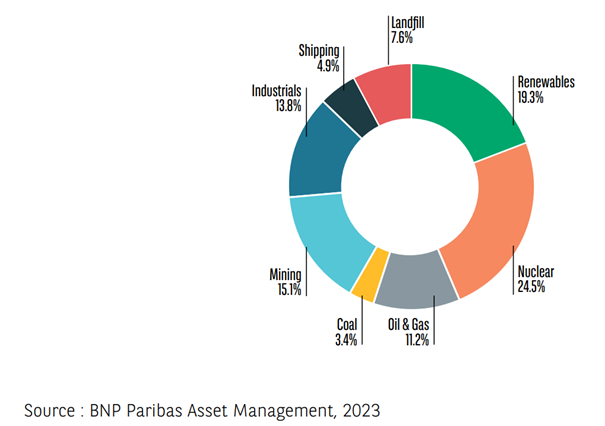
BNP Paribas Asset Management (BNPP AM) noted in its paper “Decommissioning Stranded Assets – A USD 8 trillion challenge” that in the next 20 to 30 years a large proportion of energy and industrial assets will reach the end of their operating life. This is a result of the construction cycle. For example, most US and European dams were built between 1930 and 1970 with a design life of 50 to 100 years, so half of them will need rehabilitation in the next 30 years. More wind and solar farms with life spans in the region of 20 years are being built in line with decarbonisation plans but they too will need rehabilitation at a similar time. Mining and oil & gas assets are also significantly impacted as reflected in the diagram below.
Total estimated decommissioning liabilities by sector
Under-funded existing arrangements, increasing regulatory burden and accelerated timeframes for decommissioning can lead to significant shortfall in funds for decommissioning
Reflecting the importance of planning nuclear decommissioning, many jurisdictions require operators to set up decommissioning trust funds or provide financial assurances such as guarantees or surety bonds. There are similar examples for oil & gas assets but the regulatory framework differs across jurisdictions and even where pre-funding or other security is required, funding pots risk suffering significant shortfalls.
Even if a company has planned for and fully provisioned, or pre-funded, decommissioning of its aged assets, growing regulatory requirements in many jurisdictions are increasing decommissioning costs. And liabilities may become due far earlier than expected due to national net zero commitments, decreasing economic viability or fiscal or regulatory policy changes. This can be particularly problematic as it comes at a time when financial stakeholders are inclined to reduce and/or withdraw support as the assets come to the end of their operating life.
Impact on M&A in the oil & gas, energy and mining sectors
Decommissioning liabilities are central to the merger and acquisition (M&A) strategy in the oil & gas, energy and mining sectors. They directly influence asset valuation, with buyers often applying significant discounts or requiring pre-funded decommissioning arrangements. Risk allocation is a key negotiation point, including seller-retained liabilities and cost-sharing provisions.
The oil & gas industry sits within a complex legal, regulatory and contractual framework. Therefore business partners, buyers and/or financiers and insurers need to do rigorous legal due diligence to understand obligations and liabilities connected with decommissioning within this framework, for example in relation to joint and several liability, the potential imposition of decommissioning liabilities not just on asset owning companies but also on prior owners and affiliated entities and regulatory powers to require the provision of security for future decommissioning costs..
Decommissioning – plan for decommissioning as we plan for old age
Failure to tackle the potential shortfall arising from unfunded, or underfunded, decommissioning liabilities could have major negative impacts the companies involved, the tax payer and more widely. However, BNPP AM’s view is that if we approach the issue from a different perspective, for example the model of investing pension funds, a compelling investment opportunity arises.
Below we discuss four different options proposed by BNPP AM to manage exposure to decommissioning liabilities and their relative benefits and drawbacks1:
What now?
Although companies recognise decommissioning as a critical issue, there is still work to be done to incentivise operators to sufficiently pre-fund investment in decommissioning and the development of reserve funds (including in areas where the upfront provision of decommissioning security is not already a regulatory requirement or imbedded market practice).
There is a strong link between the decommissioning of oil & gas, mining and industrial assets and the energy transition, as an accelerated energy transition is likely to lead earlier retirement of ageing fossil fuel assets in some jurisdictions. This has a fiscal dimension as tax relief for decommissioning costs accrue to operators, and tax receipts from production are reduced or cease entirely. Early decommissioning also poses serious environmental, health and safety risks if not addressed, not least because large numbers of assets are likely to fall due for decommissioning at the same time. Apart from the lack of skilled workforce capacity to undertake the relevant decommissioning work and uncertainty around available cash flow to fund this, there is also a social dimension. As jobs in the fossil fuel sector dwindle in certain jurisdictions, jobs in decommissioning-related industries and the clean energy sector are created – this requires a joined up approach to seize the opportunities connected with ensuring the workforce has the skills necessary to support the transition (and to alleviate the otherwise significant risks in not investing early to ensure workforce readiness).
Industry participants, including BNPP AM, are currently urging the UK government to consider a pre-funded Decommissioning and Energy Transition Reserve (DETRF) dedicated to the North Sea (and which could be replicated elsewhere) to ensure that long-term decommissioning costs and transition objectives will be met.2
The North Sea DETRF – or any similar fund established for transition and decommissioning purposes – would offer the asset owners who have not already pre-funded part or all of their liabilities the option to contribute to a fund. Funded in part by these contributions together with tax incentives and public sector capital and also offering the optional issuance of decommissioning bonds, the fund would contribute to the mitigation of the risks connected with decommissioning and stranded assets. Effectively, it would function as a pension scheme for the affected assets. Similar opportunities exist for other industries such as mining, industrial, waste management and shipping. Read more in BNPP AM’s paper “The Decommissioning and Energy Transition Challenge in the North Sea” about this innovative approach to ensuring safe and timely decommissioning in the North Sea.
References
- See “Decommissioning Stranded Assets – A USD 8 trillion challenge”, BNP Paribas Asset Management, 2023 for more detail on these product solutions.
- Existing decommissioning security arrangements for the UK oil and gas industry are regulated by the Offshore Petroleum Regulator for Environment and Decommissioning (OPRED) and underpinned by the Petroleum Act 1998. Relevant guidance notes are available here: DECC Document Template - Standard Numbering
[View source.]
